A focused number-sense small group needs a clear connection between the model students use, the words they say, and the next task they try. One ten frame can support that connection across counting, parts and wholes, and making 10.
Name the learning goal before choosing the page
Choose a goal narrow enough to observe during the lesson: represent a quantity to 10, describe five and some more, or find a missing part that makes 10. “Practice number sense” is a useful category, but it does not tell you which response you are listening for today.
Use a recent quick check or a brief conversation to choose a starting point. If students can count a quantity but do not connect it to the full row of five, plan around that relationship. If they can describe the quantity but struggle with the complement to 10, use the empty spaces as the focus.
Build, explain, and connect
- Build it. Put seven counters on a ten frame, filling the first row before continuing to the second. Ask what students notice before asking for an equation.
- Explain it. Invite descriptions such as five and two more, or three spaces left. Point to the parts of the model as students explain.
- Connect it. Add three counters to fill the frame. Connect the original seven and the added three to 7 + 3 = 10. Have students identify which part of the model each number represents.
Change the number while keeping the routine familiar
After the model, use a different starting quantity. Ask students to build it, describe the quantity and empty spaces, and connect the model to a new equation. Keeping the routine familiar can let you attend to the mathematical response rather than explain a new activity each time.
Do not assume that copying the teacher’s equation means a student has made the connection. Ask the student to show the parts with counters or explain the relationship in another example. If the connection is unclear, return to the model and make one step explicit.
Match practice to what you observed
If the focus is counting, choose practice that keeps one-to-one correspondence and the total visible. If the focus is parts and wholes, choose a task that asks students to connect known and missing parts. A task card, reusable mat, or number-bond page can be useful when it fits the lesson’s purpose.
Keep a short record of the response and the support needed. “Found the missing part with counters; needed help connecting it to the equation” gives you a more usable next step than “needs number sense.” Groupings can change as students show different needs.
Choose a core sequence and purposeful companions
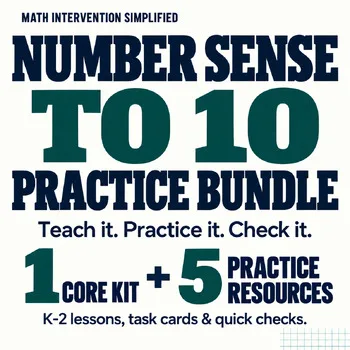
The Number Sense to 10 Bundle pairs a core intervention kit with five companion resources. The core kit includes 30 scripted lessons and an Excel tracker; the companion resources add task cards, quick checks, make-10 practice, and home practice. They are practice options around the sequence, not five additional core kits.
Use the core lessons to plan instruction, then choose a companion task that matches the skill. Check understanding and revisit the model when needed. You can also begin with the free ten-frame check or Make 10 Freebie before deciding whether the larger bundle fits your groups.
The bundle includes the core kit. Review the included-product list before buying both.
 Bundle