A quick check is most useful when it answers a specific teaching question. Before handing out a page, decide whether you want to observe counting, representation, or the missing part that makes 10.
Choose one focus for the check
For counting, ask the student to determine how many counters are shown. For representation, ask them to show a named quantity. For missing parts, ask how many more would fill the ten frame. These tasks are related, but a correct response to one does not tell you everything about the others.
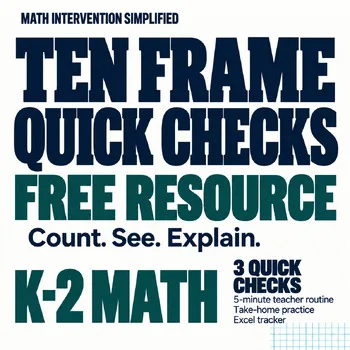
The Ten Frame Quick Check Freebie offers separate counting and missing-part checks, plus a combined check. Select the page that matches your question. The approximately five-minute routine is for one selected check page; it is not a requirement to complete every page in one sitting.
Listen to the strategy behind the answer
Keep counters available and read the directions aloud when needed. After a response, try a neutral prompt such as “How did you figure that out?” Notice whether the student counts each counter, uses the full row of five, or talks about the empty spaces.
Try this conversation: “How many counters do you see? How do you know? How many empty spaces are left?”
With seven counters, a student might see five and two more. Another might count all seven. Both can reach the correct quantity. Their explanations tell you what you may want to model, practice, or ask next.
Record the result and the support separately
Keep the selected check, date, and number correct together. Add a short note about any support: directions repeated, counters used, a model provided, or a prompt needed. A response completed after a teacher demonstration carries different information from an independent response.
Keep language observations separate from the mathematics score. A student may show an idea with counters before explaining it in a full sentence. Record what the student represented and the explanation they offered instead of treating a brief verbal response as the whole picture.
Turn an observation into a next teaching move
| If you notice… | A possible next move |
|---|---|
| Counters are skipped or counted twice | Model touching or moving each counter once, then naming the total. |
| The quantity is correct, but the student recounts every time | Explore a full row of five and describe the extra counters. |
| The student knows the quantity but struggles with the missing part | Fill the empty spaces and connect those counters to the missing addend. |
| The answer is correct with a model but unclear without one | Keep the model available and ask the student to connect it to an equation. |
These are planning possibilities, not labels for a student. Use another example, the resource’s teacher guidance, and your observations over time to decide whether a pattern is consistent.
Check again after focused teaching
Teach the selected skill, offer supported practice, and revisit it with a comparable task. Record whether the amount of support changed as well as whether the answer was correct. That makes the follow-up more informative than comparing two totals alone.
The free resource includes focused check pages, a teacher guide, take-home practice, and an Excel tracker. Start with one check and one actionable observation. You can expand the routine when it serves a clear instructional purpose.
 FREE