A Christmas Carol gives students a compact narrative in which to trace a complicated change. Pair a clear understanding of each stave with close attention to language, then use short evidence-based responses to decide what needs another look.
Begin with the original five-stave text
The six study packs in this collection accompany Charles Dickens’s original 1843 prose novella. Students need access to the complete, unabridged text. A play, film, or retelling can support a comparison, but it should not replace the assigned prose when students answer questions about Dickens’s words.
Use stave references rather than a shared page number alone. Different printings paginate the story differently. Before students respond, ask them to name the stave, identify the speaker or narrator, and give enough context for someone else to find the passage.
Trace a change without deciding the answer too early
During reading, distinguish what Scrooge says, what he does, and what the narrator tells the reader. An early promise is evidence of an intention. A later action can show whether that intention lasts. Students can revise their interpretation as the narrative supplies more evidence.
- Establish the scene. Identify who is present and whether the scene belongs to Scrooge’s present life, a memory, or a vision of a possible future.
- Locate a detail. Record a brief quotation or accurate paraphrase with its stave reference.
- Explain the effect. Connect the detail to a belief, relationship, or decision. Explain what it shows instead of stopping at a plot summary.
- Revisit the claim. Ask which later moment supports, complicates, or changes the interpretation.
Return each word to its sentence
For unfamiliar vocabulary, ask students to suggest a meaning from the surrounding language, identify the clue they used, and check the meaning that fits that particular use. A familiar modern meaning can be misleading in an older text.
| Move | Student response |
|---|---|
| Infer | A possible meaning and a clue from the passage. |
| Verify | The meaning that fits the word’s use in this sentence. |
| Explain | What the word helps the reader understand about the scene or tone. |
| Apply | A new sentence that makes the intended meaning clear. |
Keep a correction visible when a first inference does not fit. The useful learning is the explanation of why the student changed the meaning, not simply replacing one answer with another.
Use the response to choose the next teaching move
A selected-response check can reveal confusion about an event, speaker, or relationship. A short written explanation shows how a student connects the evidence to an interpretation. Use both forms of evidence before deciding that a learner is ready for a longer response.
When students confuse a vision with an inevitable event, revisit the language of possibility in Stave IV. The final spirit does not give Scrooge a spoken guarantee. Stave V supplies the actions and the narrator’s account that readers can use to evaluate his change.
The assessment pack includes five stave quizzes and one whole-text assessment. Open text is recommended for all items. If you choose closed-text conditions for multiple choice, announce them beforehand and return the novella for every short response. The explained keys, sample responses, and shared claim-evidence-reasoning rubric support scoring. Keep conditions consistent when comparing results, and use the directions for the particular assessment.
Choose the resource for the job
| Resource | Primary purpose |
|---|---|
| Reading Companion | Use close-reading prompts, character and relationship analysis, theme work, and a final evidence-based response. |
| Vocabulary & Word Study | Infer contextual meanings, apply words in new sentences, compare meanings, and examine word forms. |
| Literary Analysis & Essay Writing | Move from close analysis of literary choices to a defensible claim, evidence-based reasoning, an essay draft, and revision. |
| Seminar & Discussion | Prepare evidence, explore competing interpretations, listen and respond to peers, then reflect on the discussion. |
| Quizzes & Assessments | Use stave quizzes or the whole-text assessment with explained keys, sample responses, and a shared rubric. |
| Review & Retrieval Practice | Revisit the sequence of events, connect ideas across staves, and explain what textual details support an interpretation. |
| Complete Study Bundle | Combine all six packs with a six-page Teacher Unit Roadmap that offers compact and extended pacing options. |
| The Case for Change (interactive activity) | Investigate four encounters, collect evidence in a local notebook, and develop an argument using passages from different encounters. |
The six individual packs each include printable PDFs and an editable native Google Docs student workbook. The complete bundle contains those same six packs plus a Teacher Unit Roadmap; check its included-product list before buying an individual pack as well. Teacher materials for those six packs are supplied as PDFs. The Case for Change is a separate browser-based activity and is not included in the six-pack bundle. It uses original prose passages and can follow the novella or a faithful classroom adaptation. Students collect evidence and copy their completed response into the assignment their teacher provides. Review the individual TPT preview for the exact activities, included files, grade guidance, and current price. The six study packs require the complete literary text, which is not included.
Start with the support your class needs. Reading work can supply evidence for a later response; vocabulary practice can clarify the passage students will discuss. After students finish all five staves, use whole-text discussion to test interpretations before the essay workshop. Choose review tasks to revisit specific gaps rather than assigning every page. The bundle roadmap helps teachers select a sequence and adapt the pace.
Browse the A Christmas Carol resource collection, or compare the individual packs, complete bundle, and standalone interactive activity below. Teachers who need a reference copy can consult the original text and John Leech illustrations.
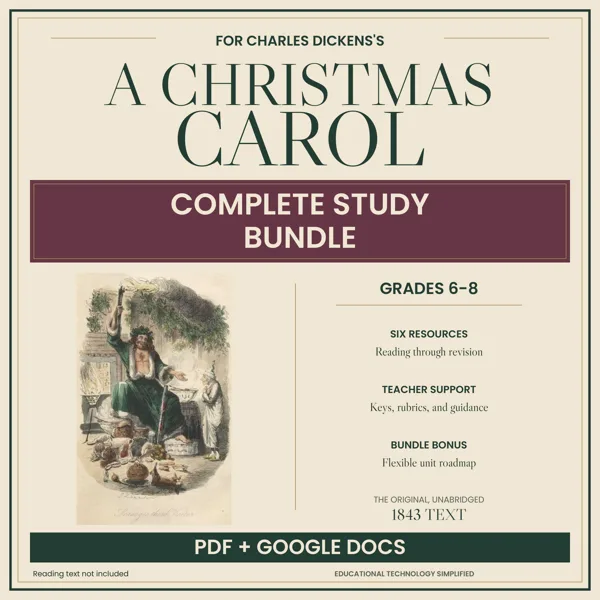 Bundle
A Christmas Carol Complete Study Bundle | PDF + Google Docs
VIEW ON TPT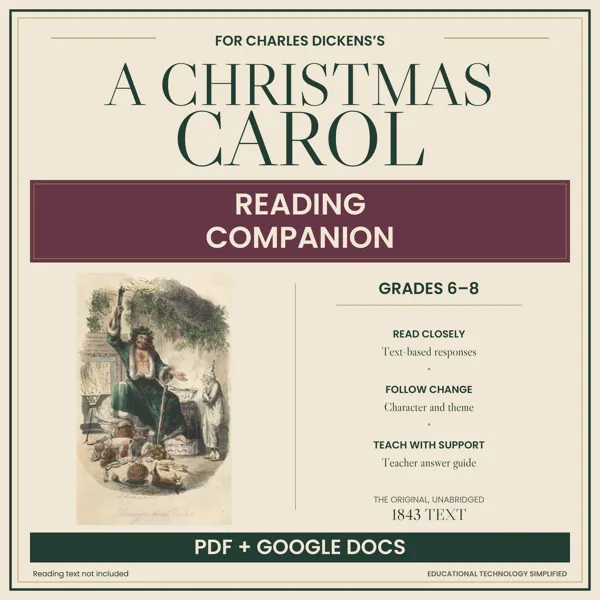 Reading companion
A Christmas Carol Reading Companion | Questions & Activities | PDF + Google Docs
VIEW ON TPT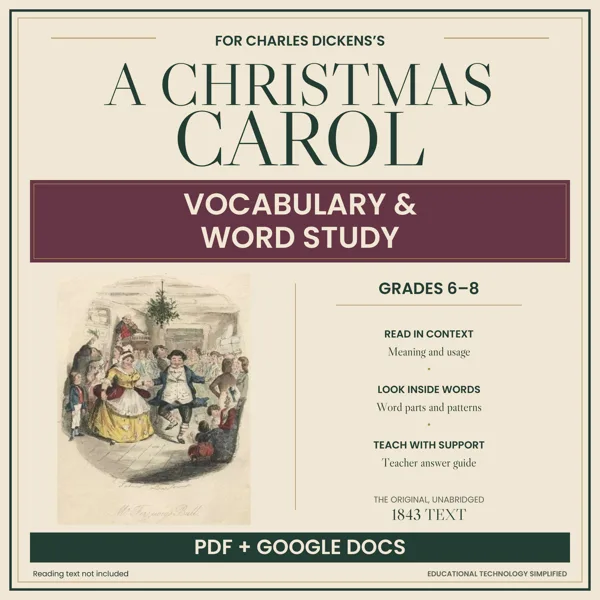 Vocabulary
A Christmas Carol Vocabulary & Word Study | PDF + Google Docs
VIEW ON TPT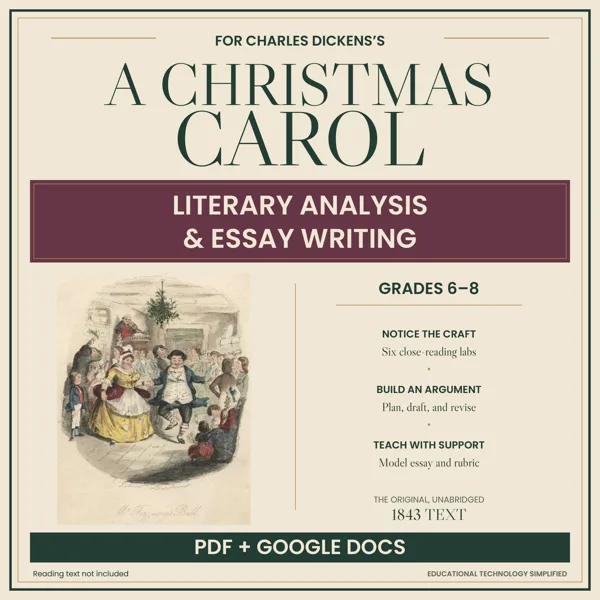 Analysis & writing
A Christmas Carol Literary Analysis & Essay Writing | PDF + Google Docs
VIEW ON TPT Discussion
A Christmas Carol Seminar & Discussion | Grades 6–8 | PDF + Google Docs
VIEW ON TPT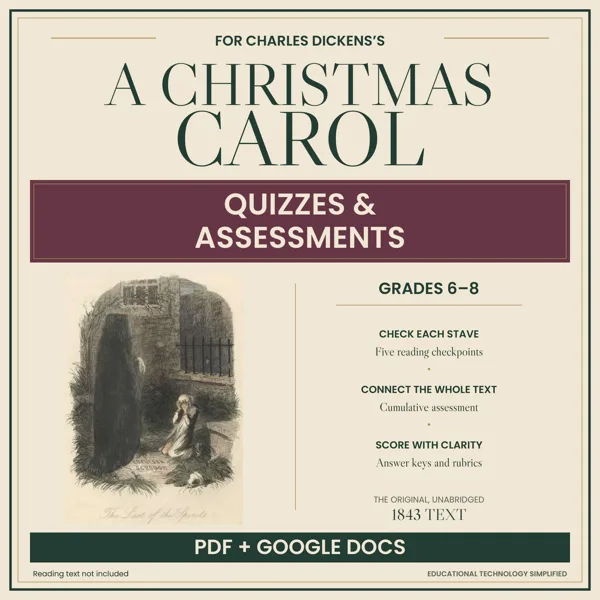 Assessment
A Christmas Carol Quizzes & Assessments | PDF + Google Docs
VIEW ON TPT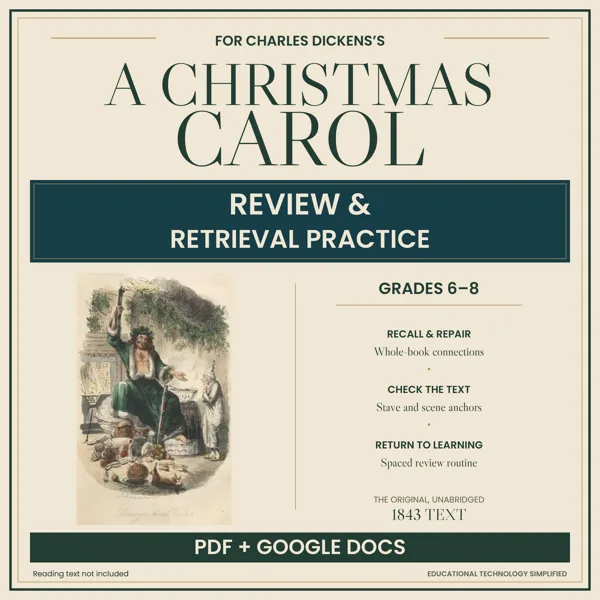 Puzzle & review
A Christmas Carol Review & Retrieval Practice | PDF + Google Docs
VIEW ON TPT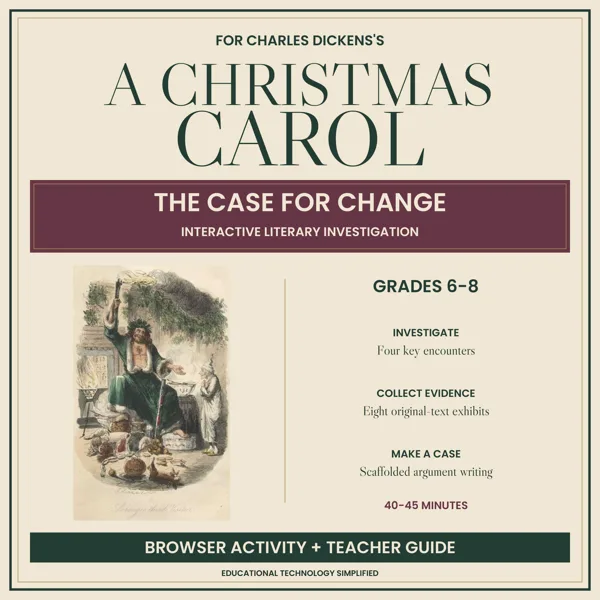 Interactive activity